Industrial refrigeration powered by physics — not refrigerants. MCS technology delivers up to 40% energy savings with zero GWP and no pressurized gases.
The magnetocaloric effect (MCE) is a natural phenomenon where certain materials change temperature in response to a magnetic field — no gases, no compressors, no emissions.
MCM enters the magnetic field. Electron spins align — the material releases heat and warms up.
Warm-side heat exchanger transfers released heat to the ambient environment, completing the hot cycle.
The MCM leaves the field. Electron spins randomize — the material absorbs energy and cools down.
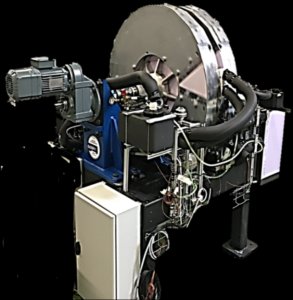
Cold-side heat exchanger captures the cooling effect. Multi-loop rotation (~18 rpm) creates a continuous, stable thermodynamic cycle.
Compared to conventional refrigeration using HFCs, CO₂, or NH₃, MCS eliminates the fundamental trade-offs that have defined the industry for decades.
Solid magnetocaloric materials replace all gaseous refrigerants. GWP = 0. No F-Gas compliance burden, no leak risk, no PFAS concerns.
No pressurized circuits means reduced risk, simplified installation, and less stringent safety requirements on-site.
No compressor, no pistons, no oil management. Fewer failure points translates directly to lower operational costs.
Up to 65% of Carnot efficiency with 40% lower energy consumption — a benchmark vapor-compression systems rarely approach.
Smooth rotary motion at ~18 rpm generates minimal vibration and noise — ideal for retail and food production environments.
From supermarket refrigeration to cold chain logistics, MCS systems are engineered for continuous, high-demand industrial operation.

Central cooling for retail stores (~1,000 m²). A typical supermarket requires 100–120 kW of continuous refrigeration — precisely MCS's target range.
100–120 kW
Continuous-duty refrigeration for food manufacturing and logistics. Lower OPEX and GWP = 0 align with sustainability requirements across the supply chain.
Industrial scale
Precision temperature control for manufacturing. Operates across –120 °C to +50 °C, suitable for the most demanding process requirements.
–120 °C to +50 °CCurrent generation MCS modules are designed for industrial deployment, with a clear path to full-scale production systems.
MCS systems require a higher upfront investment than conventional compressor-based units. However, substantially lower energy bills and reduced maintenance costs compound over time to deliver a significantly better Total Cost of Ownership.
For a supermarket running 24/7, the payback window is attractive, and the system eliminates exposure to refrigerant phase-out regulations and carbon taxes.
Whether you're planning a new facility or replacing legacy cooling infrastructure, our team is ready to evaluate your project.